Read the equals sign as a relationship
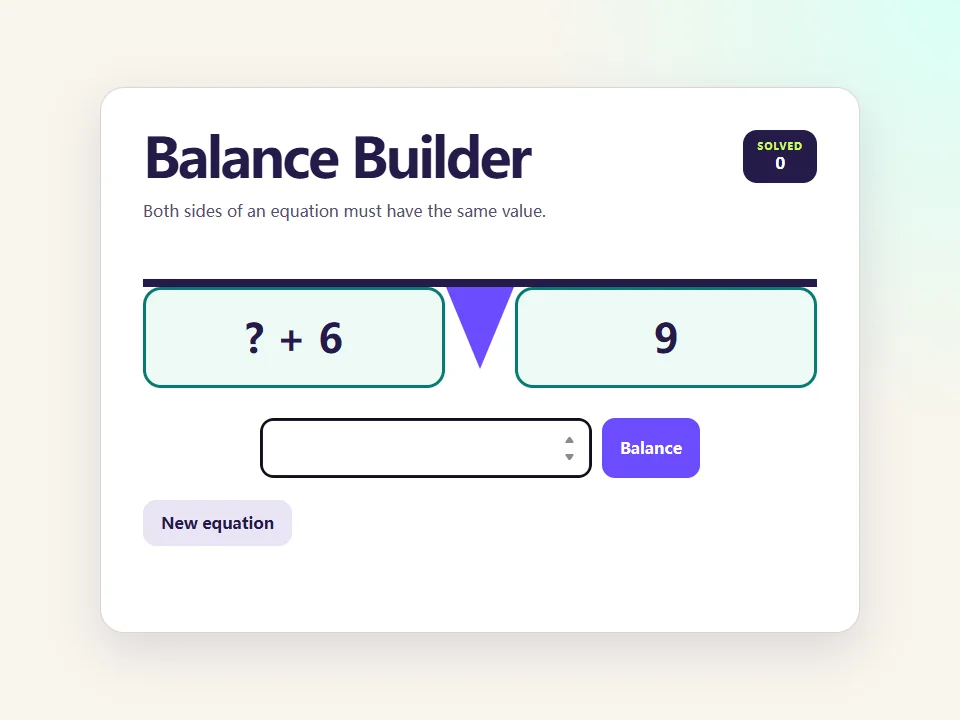
Balance Builder presents addition, subtraction, and multiplication equations generated from a known solution. The repeated action is to find the value that makes the left side and right side represent the same amount. This is different from reading the equals sign as “write the answer next,” a habit that can fail when the blank appears before the equals sign.
We tested generated equations against their stored solutions on pointer, keyboard, and narrow touch layouts. The interface reports whether the submitted value balances the equation. It cannot see the strategy used, so a correct guess and a reasoned inverse operation look identical to the software.
Worked case: 17 + □ = 31
The missing addend can be found by asking what must be added to 17 to reach 31. Subtracting 17 from both sides gives 14. A learner can check by rebuilding the original equation: 17 + 14 = 31. The check is essential because it catches a common reversal such as 17 − 31.
For □ − 9 = 18, adding 9 to both sides gives 27. For 6 × □ = 42, dividing both sides by 6 gives 7. Naming the operation and its inverse makes the method reusable instead of tying it to the visual position of the blank.
Use a physical balance when the notation is new
Write each side on a separate card or draw a balance beam. Whatever change is made to one side must preserve the shared value. This concrete step is especially useful for US elementary and middle-school learners encountering nontraditional equation forms.
After a correct game response, ask the player to state the check aloud. If the check cannot be explained, replaying more rounds may only reinforce answer chasing. One explained equation is a better learning sample than ten unexplained submissions.
Limits and best fit
The game uses whole-number forms and a compact answer field. It does not cover symbolic variables, negative-number transformations, or formal proof of equivalence. Those are logical next steps, not outcomes the current game should claim.
We recommend Balance Builder for learners who already understand the represented operations but need practice seeing equality as balance. If subtraction meaning or multiplication groups are still uncertain, teach that prerequisite with objects or drawings before using the game.
Common wrong answers and what they reveal
For 17 + □ = 31, an answer of 48 suggests the learner combined every visible number instead of interpreting the relation. An answer of 14 with no check may be correct but fragile. For □ − 9 = 18, answering 9 can indicate attention to the subtracted value rather than the unknown starting amount. These patterns guide the next explanation more effectively than a total score.
Ask the learner to cover the blank and tell a short story for the equation: “A box held some counters. Nine were removed and eighteen remain.” Reconstructing the starting amount as 27 connects inverse operations to meaning. Then return to the symbolic form and verify 27 − 9 = 18.
A useful exit question changes the blank’s position while preserving the numbers, such as 31 − 17 = □. If the relationship remains clear, the learner is less dependent on a memorized visual layout. If not, model the balance again before increasing difficulty.
Do not describe moving a number across the equals sign as if its sign changes by magic. That shortcut can conceal the legal operation performed on both sides. Saying “subtract 17 from both sides” or “add 9 to both sides” keeps the equality principle visible and prepares the learner for later algebra.