Grades 3–6 · Ages 8–12
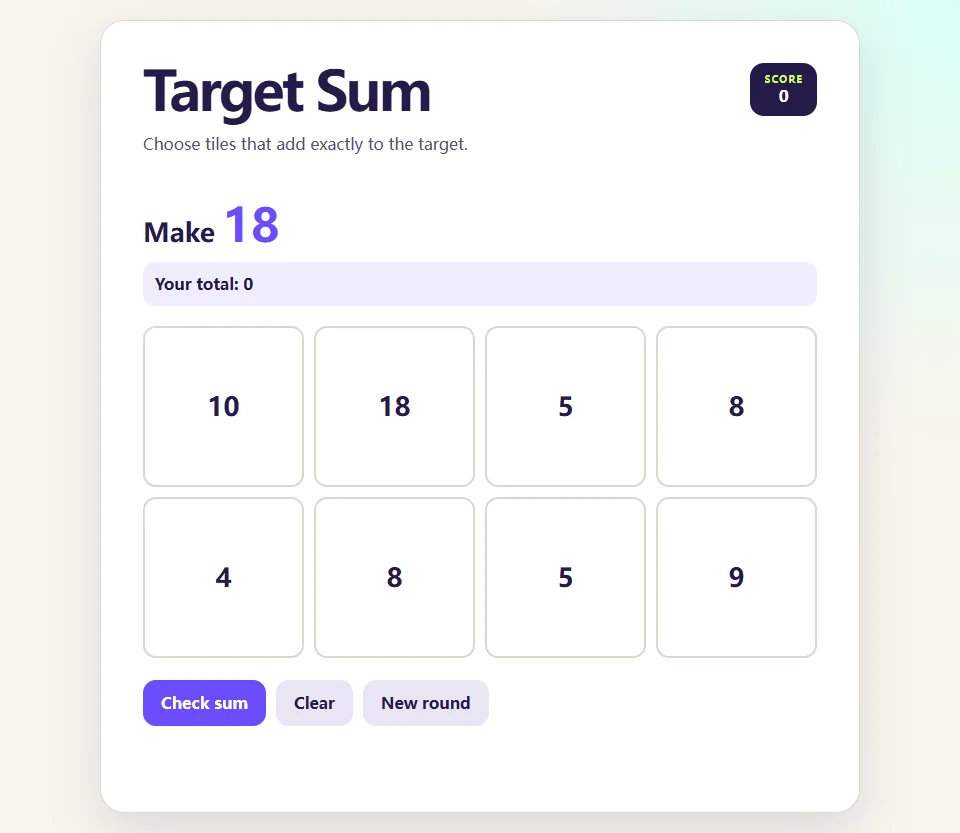
Target Sum
Choose number tiles that add exactly to the target before the round ends.
Independent games for browser play
Play original number, logic, fraction, and strategy challenges built for laptops, Chromebooks, tablets, and phones—without an account or download.
Start playing
Grades 3–6 · Ages 8–12
Choose number tiles that add exactly to the target before the round ends.
Grades 4–8 · Ages 9–14
Find the missing value in a row or column pattern using the fewest hints.
Grades 4–7 · Ages 9–13
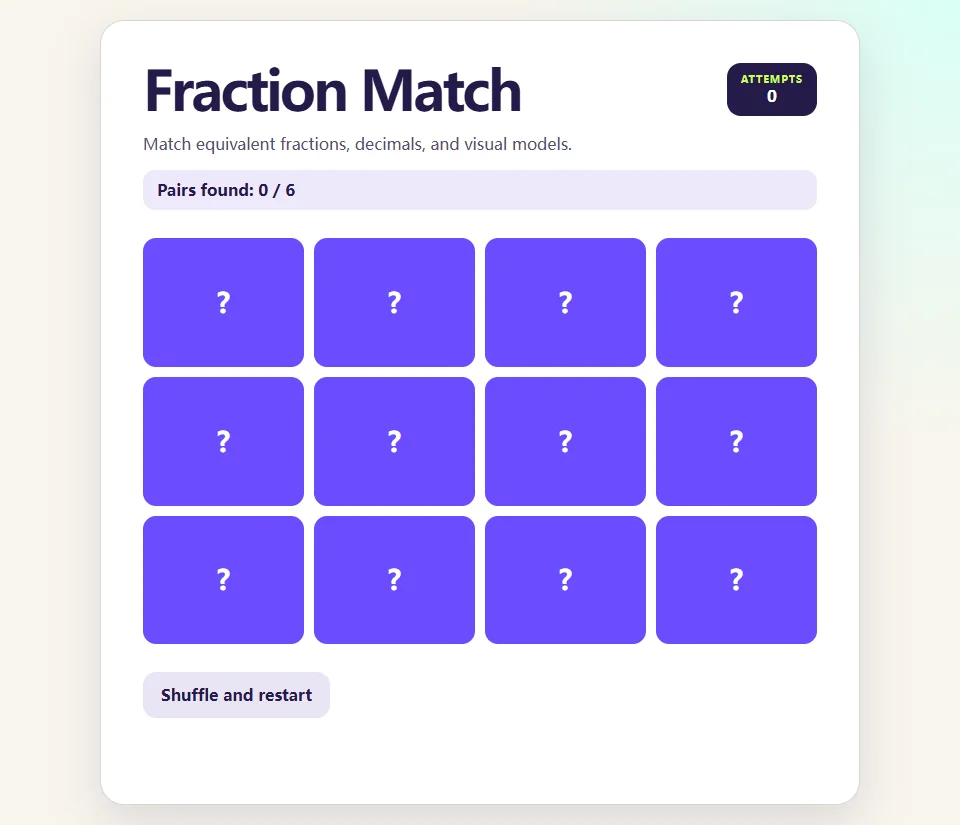
Pair a fraction with its visual model and equivalent decimal.
Grades 3–6 · Ages 8–12
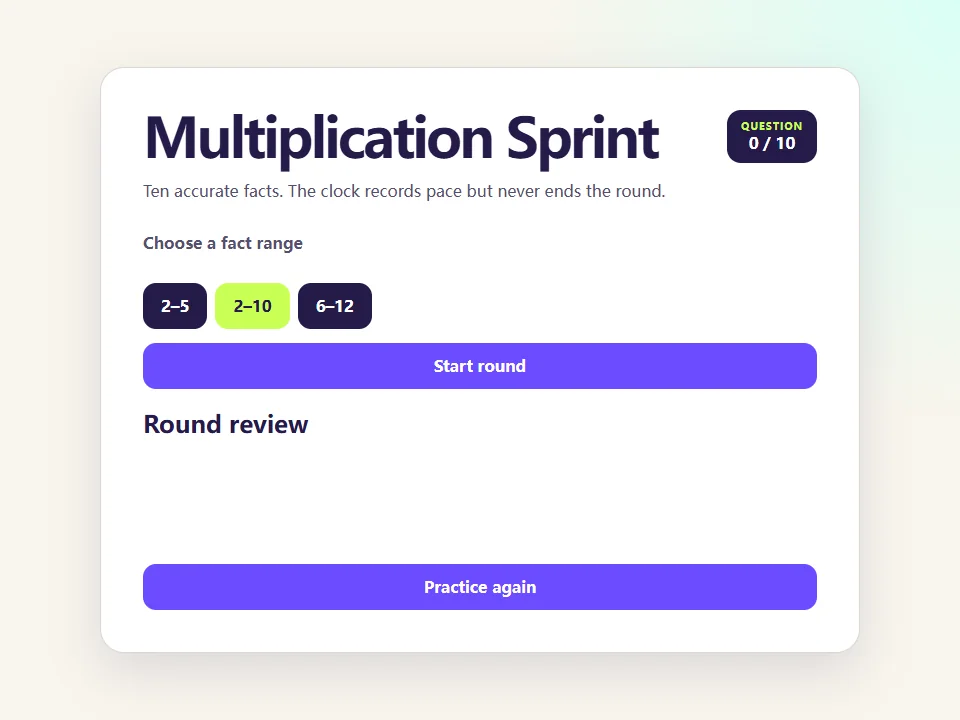
Solve a focused set of multiplication facts while accuracy matters more than speed.
Grades 3–7 · Ages 8–13
Complete an equation by keeping both sides of a visual balance equal.
Grades 4–8 · Ages 9–14
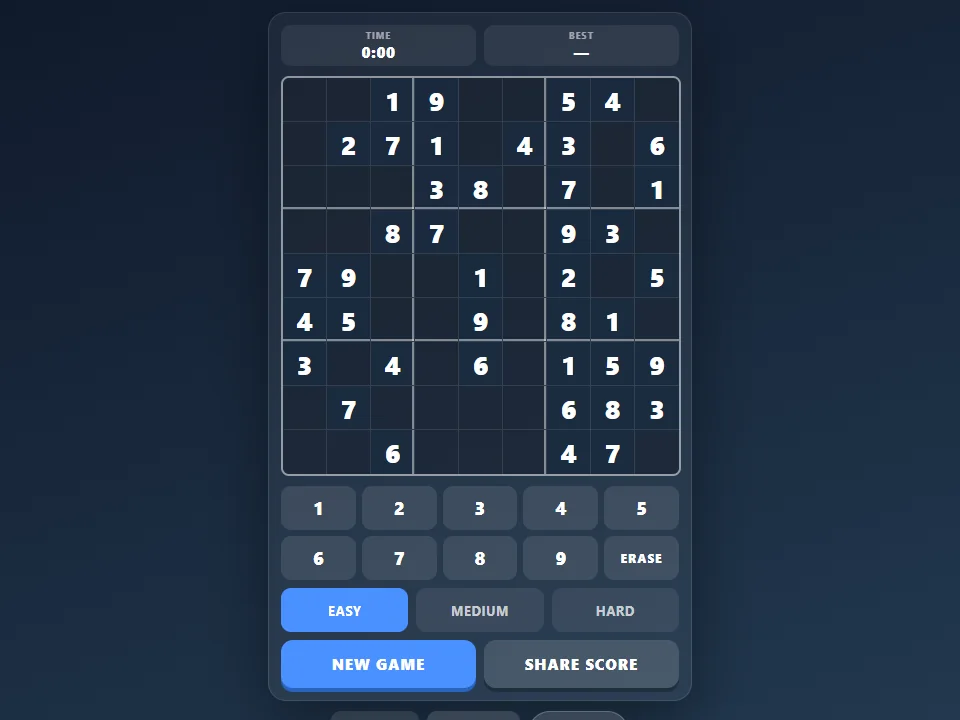
Switch every light on while each move changes a predictable group of neighbors.
Grades 4–8 · Ages 9–14
Compare candidate rules and identify the one that fits every number in a sequence.
Grades 4–7 · Ages 9–13
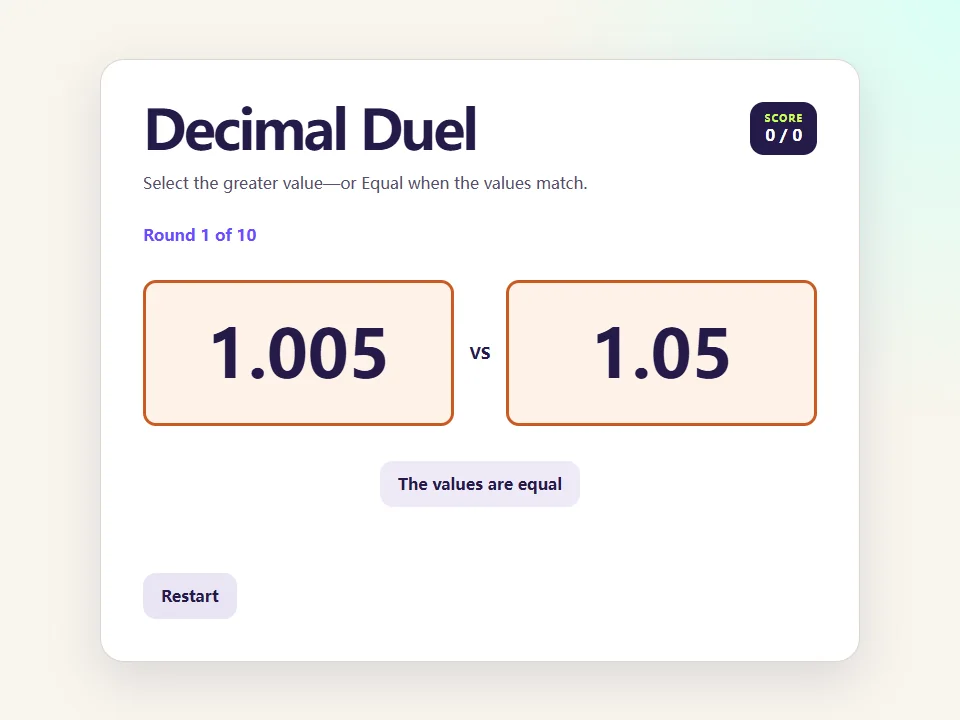
Choose the greater decimal and use place value—not digit length—to decide.
Grades 4–7 · Ages 9–13
Build every whole-number factor pair for a target without repeating a pair.
Grades 4–7 · Ages 9–13
Write a quotient and remainder, then verify that they rebuild the dividend.
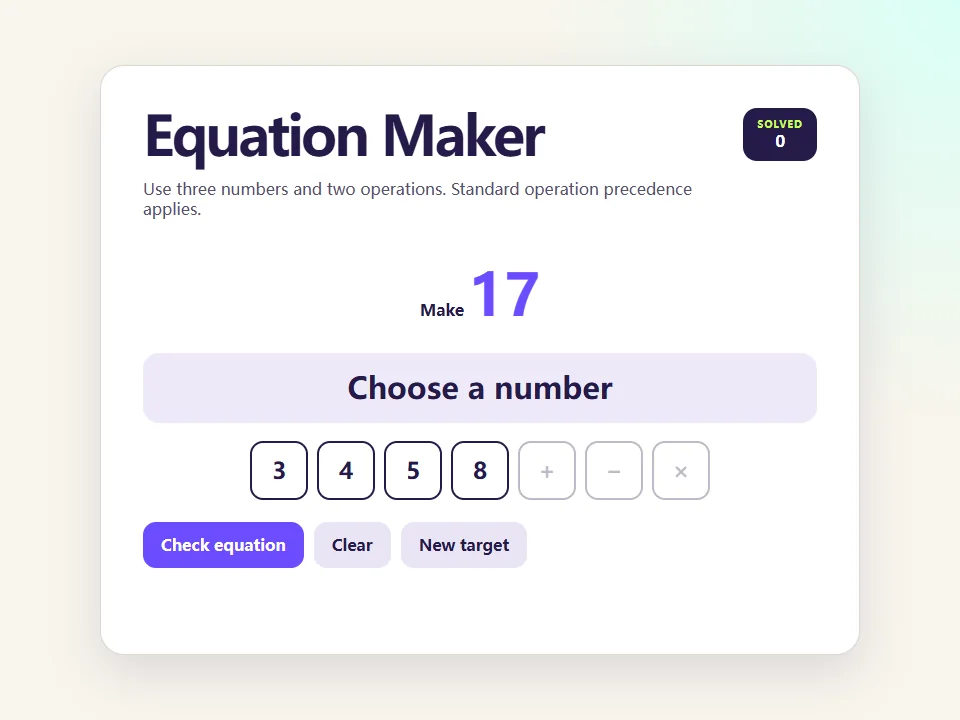
Grades 5–8 · Ages 10–14
Arrange four number and operation tiles into a true equation for the target.
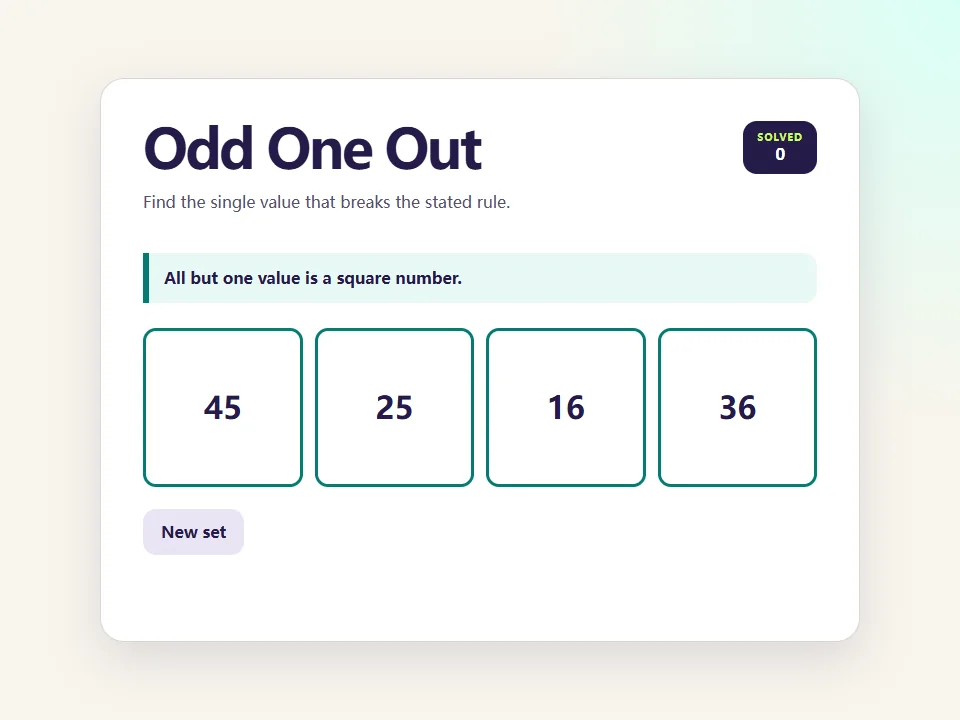
Grades 4–8 · Ages 9–14
Find the value that breaks a stated mathematical rule and explain the evidence.
Grades 3–7 · Ages 8–13
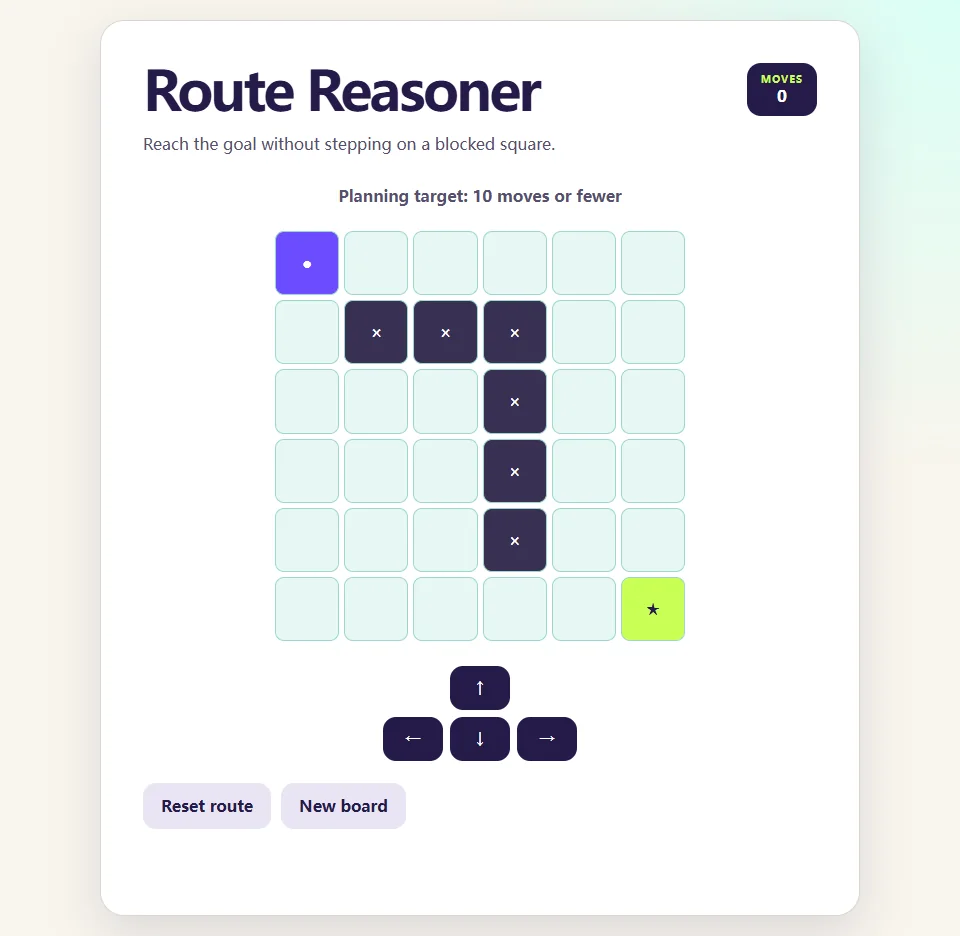
Plan a path across a grid while obeying direction and obstacle constraints.
Grades 5–8 · Ages 10–14
Sort numbers as prime or composite and inspect a factor when a number is composite.
Grades 3–6 · Ages 8–12
Place a fraction at the matching position between zero and one.
Find the right fit
Build number sense
Practice arithmetic and flexible number thinking through short, replayable challenges. Each game explains the skill it uses, the controls, and the limits of what it can teach.
Explore math games →◇Reason step by step
Use patterns, constraints, and elimination instead of guessing. These games reward a clear plan and make it easy to review why an answer worked.
Explore logic games →123See useful relationships
Explore sums, factors, fractions, and place value with visual feedback designed for quick practice on a laptop, Chromebook, tablet, or phone.
Explore number games →Learn beyond the score
Editorial standards · 8 min read
Our repeatable method for checking learning fit, controls, privacy, accessibility, and classroom practicality.
Read the guide →Parents & teachers · 9 min read
A practical way to match a browser game to what a learner knows now and what they should practice next.
Read the guide →Parents & teachers · 8 min read
What to inspect before a child opens a free game: ads, accounts, chat, permissions, links, and data storage.
Read the guide →Game walkthrough · 9 min read
A worked strategy for choosing number tiles, checking the running total, and finding a second solution in Target Sum.
Read the guide →Game walkthrough · 10 min read
Use aligned place values, equivalent zeros, and concrete comparisons to avoid the most common Decimal Duel mistakes.
Read the guide →Game walkthrough · 9 min read
Understand the neighbor rule, avoid random tapping, and solve Logic Lights with repeatable observation and reset strategies.
Read the guide →Game walkthrough · 10 min read
A systematic search method for Factor Pairs, with worked examples for 36 and 48 and a clear stopping rule.
Read the guide →Game walkthrough · 9 min read
Place fractions accurately between zero and one by partitioning equal intervals and interpreting numerator and denominator.
Read the guide →Game walkthrough · 9 min read
A five-day practice routine that uses short rounds, error review, and adjustable fact ranges without turning every session into a race.
Read the guide →Game walkthrough · 9 min read
Use inverse operations and a balance model to solve missing-value equations without treating the equals sign as an instruction to calculate.
Read the guide →Game walkthrough · 8 min read
A repeatable method for reading rows and columns, testing a pattern, and checking the missing value in Number Grid.
Read the guide →Logic strategy · 9 min read
Compare candidate rules across every term, recognize alternating patterns, and explain why a tempting sequence rule fails.
Read the guide →Game walkthrough · 9 min read
Find quotient and remainder, enforce the remainder rule, and verify every answer with divisor × quotient + remainder.
Read the guide →Number strategy · 9 min read
Classify whole numbers as prime or composite by checking possible divisors only through the square root.
Read the guide →Fraction strategy · 9 min read
Connect fractions, decimals, and area models by converting or scaling them instead of matching by visual resemblance.
Read the guide →For adults helping learners
Our notes separate tested behavior from educational judgment, name limitations, and give you a concrete way to use each activity.