
Two answers must work together
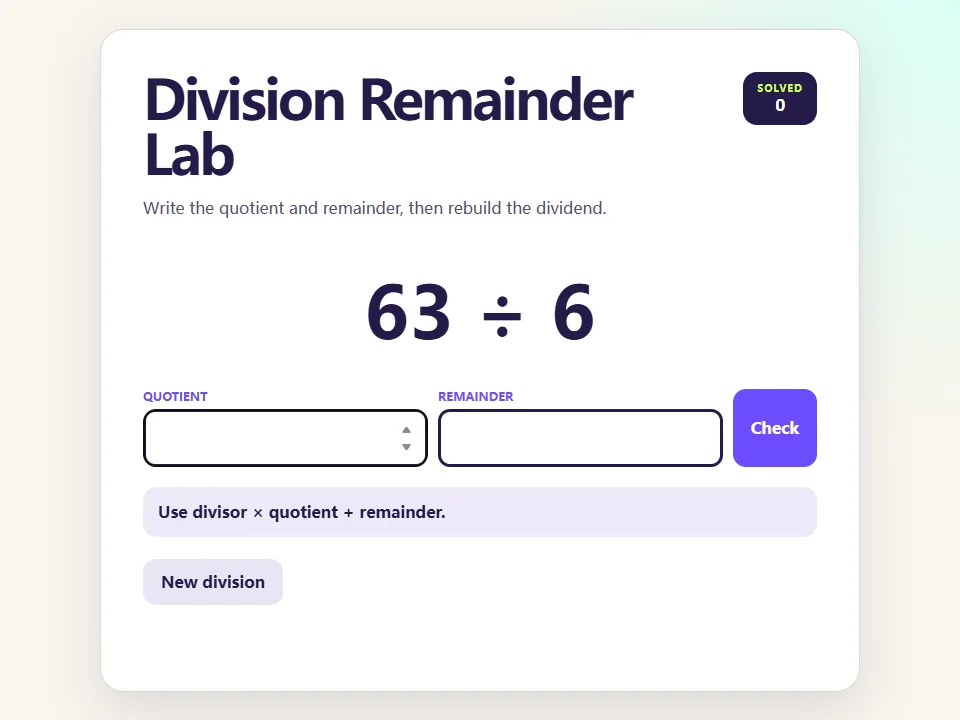
A division-with-remainder response contains a quotient and a remainder. Both must satisfy the original dividend, and the remainder must be smaller than the positive divisor. Division Remainder Lab generates each prompt from a known divisor, quotient, and valid remainder, then checks the submitted pair with the reconstruction equation.
We tested correct pairs, swapped values, oversized remainders, blanks, and keyboard submission. The local validator catches combinations that do not rebuild the dividend. It does not show a long-division algorithm, so learners who need procedural instruction should use a worked model alongside the game.
Worked case: 157 divided by 12
The largest multiple of 12 not exceeding 157 is 12 × 13 = 156. The quotient is 13 and the remainder is 1. Check: 12 × 13 + 1 = 157. Also check the constraint 1 < 12.
A response of quotient 12 and remainder 13 reconstructs 157 as well, but it violates the remainder rule because 13 is not smaller than 12. This example shows why reconstruction alone is necessary but not sufficient.
Estimate before calculating
Round the dividend to a nearby friendly multiple to predict the quotient range. For 157 ÷ 12, knowing 120 ÷ 12 = 10 and 180 ÷ 12 = 15 places the quotient between 10 and 15. That estimate makes a mistyped quotient such as 31 easy to reject.
After each game response, say the multiplication check in a full sentence. If a learner repeatedly produces a remainder larger than the divisor, regroup that remainder into one or more additional groups and adjust the quotient.
Meaning depends on context
A numeric remainder does not automatically tell a real-world answer. If 157 students ride buses holding 12, thirteen full buses leave one student and a fourteenth bus may be needed. If 157 inches of ribbon are cut into 12-inch pieces, the remainder is one inch. Context determines whether to round, report, or reinterpret the remainder.
The game deliberately practices the numerical structure only. We recommend pairing it with word problems so players do not assume every remainder should be handled the same way.
Diagnose the error before another round
If the quotient is one too small and the remainder exceeds the divisor, regroup the remainder into another full group. If the quotient is reasonable but reconstruction misses the dividend, check the multiplication fact before repeating long division. If quotient and remainder are swapped, restate their roles: the quotient counts full groups, while the remainder is what cannot form another full group.
Consider 83 ÷ 6. A response of 12 remainder 11 rebuilds 83, but eleven contains another group of six. Regrouping gives 13 remainder 5, and 5 < 6. This case is useful because both pairs satisfy the addition equation while only one follows the conventional remainder rule.
In US grade-level use, terminology may differ from another curriculum, but the invariant does not: dividend = divisor × quotient + remainder, with a nonnegative remainder smaller than a positive divisor. The game stays within that whole-number convention and does not cover negative remainders or decimal quotients.
A final reasonableness check compares the quotient with a nearby benchmark. If 83 is divided into groups of 6, the result must be more than 10 groups because 6 × 10 is 60, and fewer than 20 because 6 × 20 is 120. A quotient outside that interval signals an error before exact reconstruction.
Write the check immediately after the submitted pair. Delaying it until several problems later turns verification into answer copying instead of a way to catch the current calculation.