
Start at 1 and search in order
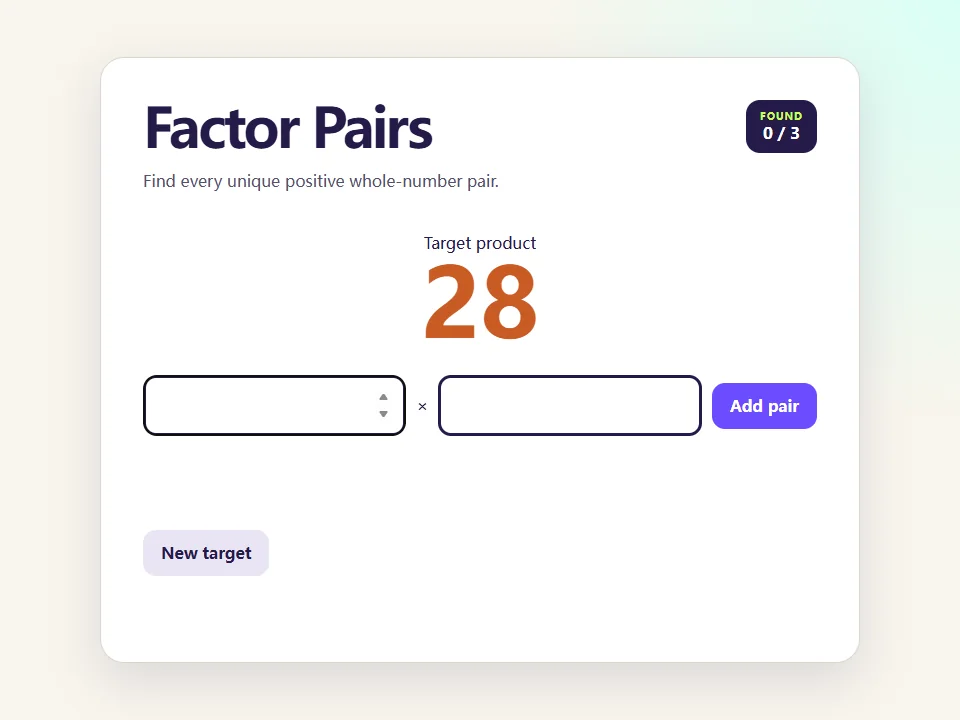
Factor Pairs gives a target product and asks for every unique pair of positive whole numbers. Begin with 1, then test 2, 3, 4, and so on. A number is a factor only when the division leaves no remainder. Searching in order prevents both gaps and repeated reversed pairs.
The current game computes the expected pairs locally, rejects non-whole values, and treats 3 × 12 as the same pair as 12 × 3. Its evidence is the multiplication equation itself: a submitted pair is valid only when the two entries multiply to the displayed target.
Worked example: all factor pairs of 36
Start with 1 × 36. Two divides 36 evenly, so add 2 × 18. Three also divides evenly, giving 3 × 12. Four gives 4 × 9. Five does not divide evenly. Six gives 6 × 6.
At 6, both factors meet. Continuing to 9 would only reverse the pair 4 × 9, and continuing to 12 would reverse 3 × 12. The complete unique list is therefore 1 × 36, 2 × 18, 3 × 12, 4 × 9, and 6 × 6.
The square-root stopping rule in plain language
Factor pairs move toward each other. The first factor increases while the matching second factor decreases. Once the first factor reaches or passes the second, every later pair is a reversal of one already tested. For a perfect square such as 36, the two factors meet at 6.
You do not need to calculate a square root formally to use the rule. Stop after the first factor would become larger than its partner. In the interface, keeping the discovered pairs sorted by the smaller factor makes this meeting point visible.
Worked example: 48 without missing a pair
The ordered test produces 1 × 48, 2 × 24, 3 × 16, 4 × 12, and 6 × 8. Five does not divide 48. Seven does not divide 48. The next factor, 8, would give 8 × 6, which reverses the final pair already recorded. The search is complete.
A common mistake is to stop after familiar multiplication facts such as 6 × 8 and forget 3 × 16. Testing possible first factors in numerical order avoids relying on whichever facts come to mind first.
Use invalid attempts as divisibility evidence
If 5 × 9 is submitted for a target of 48, the product is 45, so the pair is invalid. Instead of treating this as a dead end, note that 48 ÷ 5 is not a whole number. That observation rules out 5 as a factor and allows the systematic search to continue at 6.
If the product is correct but the pair is rejected as a duplicate, reverse-order checking worked as intended. Record unique pairs with the smaller factor first. This consistent notation makes comparison and completion easier.
Who benefits and what comes next
The game fits learners connecting multiplication facts to factors, divisibility, common factors, or rectangular arrays. It uses positive whole numbers only and does not teach negative factors or prime factorization. A complete list shows organization as much as recall.
Our recommendation is to follow one finished target by asking whether the target is prime, composite, or a perfect square and which evidence in the pair list supports the answer. That extension turns a game result into a statement about number structure.
Connect factor pairs to rectangles and common factors
Draw a rectangle for two pairs from the list. A 36-square array can be 1 by 36, 2 by 18, 3 by 12, 4 by 9, or 6 by 6. The unchanged area shows why every valid pair represents the same target while the changing side lengths reveal unique arrangements.
For an extension, compare the pair lists for 36 and 48 and circle shared factors. This produces common factors from visible evidence before introducing a greatest-common-factor procedure. The game itself does not perform that comparison, so the paper step is where the new claim should be explained.