Match value, not appearance
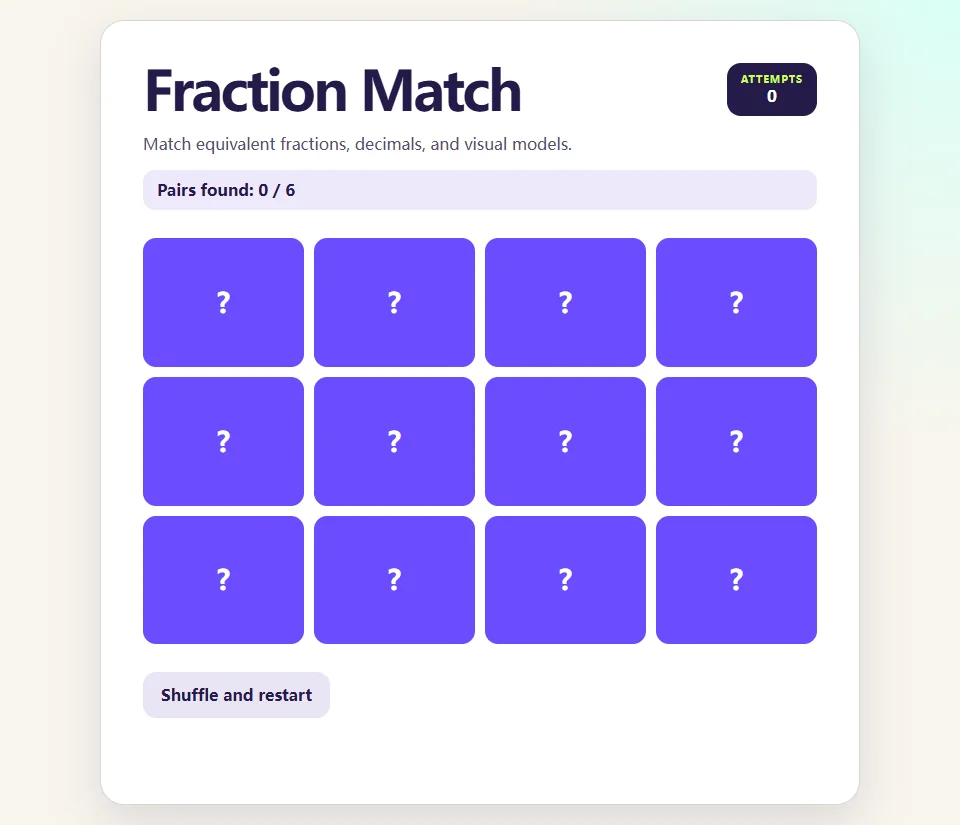
Fraction Match uses a reviewed set of fraction, decimal, and area-model equivalents. A pair may look different while representing the same point on a number line or the same part of one whole. The useful question is not “Do these cards look alike?” but “Can I show that their values are equal?”
We tested every card pair, mismatches, completed boards, and responsive layouts. Because the pair bank is finite, repeated play can eventually produce memory of card locations. That memory supports the game mechanic but is not evidence by itself that fraction equivalence is understood.
Worked case: 3/4 and 0.75
Dividing 3 by 4 gives 0.75. Another route is to scale fourths to hundredths: 3/4 × 25/25 = 75/100, which is 0.75. An area model with 75 of 100 equal cells shaded represents the same value.
The denominator describes the number of equal parts in one whole. A drawing divided into unequal pieces is not a valid fraction model even if three of four regions are colored. Equality of partition size is part of the evidence.
Use benchmarks to reject mismatches
Compare each card with 0, one-half, and 1 before doing exact conversion. For example, 2/3 is greater than one-half, while 0.4 is less than one-half, so they cannot match. This fast check reduces calculation and catches conversions placed on the wrong side of a benchmark.
When two symbolic fractions are candidates, simplify them or use cross-products. For 6/8 and 3/4, both simplify to 3/4. For 2/5 and 3/7, 2 × 7 = 14 while 3 × 5 = 15, so they are close but not equal.
A stronger replay routine
Before flipping a second card, predict one equivalent form for the first card. After a match, explain it with conversion, scaling, or a benchmark. After a mismatch, compare the two values rather than treating the turn as lost.
Our judgment is that the game works best after learners know that fractions describe equal partitions. It can strengthen connections among representations, but it should not be used to introduce fraction meaning without physical or drawn models.
Common mismatches and corrective prompts
A learner may match 1/4 with 0.4 because both show the digit 4. Ask for the fraction as hundredths: 1/4 = 25/100 = 0.25, while 0.4 = 40/100 = 2/5. Another common mismatch pairs 3/5 with 0.35. Reading 3/5 as three divided by five or scaling to 60/100 gives 0.6, which exposes the digit-matching shortcut.
Area models can also mislead when learners count shaded pieces without checking the total number of equal pieces. Ask “How many equal parts make the whole?” before “How many are shaded?” If the regions differ in size, the picture cannot justify the symbolic fraction under the usual area model.
For a transfer check, give three blank cards—a fraction, decimal, and rectangle—and ask the learner to create an equivalent set not already shown. Explaining the conversion is stronger evidence than remembering where a pair appeared during the game.
Keep the whole consistent when comparing area models. Half of a small rectangle and half of a large rectangle are equivalent fractions but not equal physical areas. The fraction describes a relationship within each chosen whole, so an explanation must identify what counts as one complete unit.
End the session by sorting three values from least to greatest. Ordering requires the learner to coordinate more than one equivalence and reveals whether a benchmark such as one-half is being used consistently.