
The denominator describes equal intervals
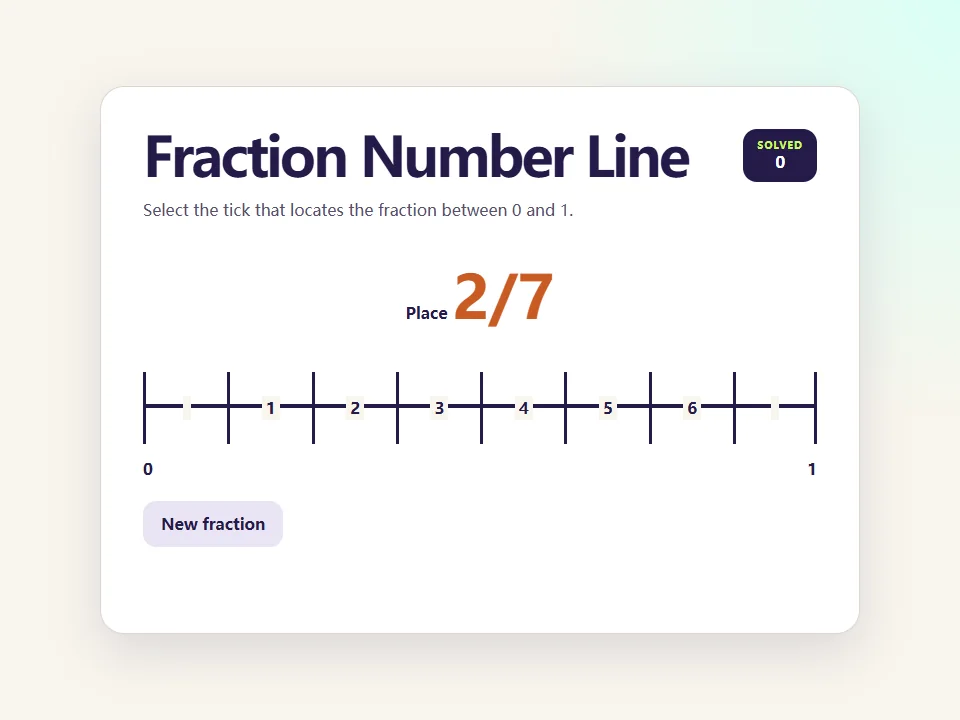
Fraction Number Line shows a target fraction between zero and one. The denominator tells how many equal intervals divide the full distance from zero to one. The numerator tells how many of those intervals to travel from zero.
Count spaces, not vertical marks. A line divided into fourths has four intervals but five boundary marks when zero and one are included. Confusing marks with intervals shifts every answer and is one of the clearest errors this game can reveal.
Worked case: place three fourths
For 3/4, divide the distance from zero to one into four equal intervals. Begin at zero and move three intervals: the first reaches 1/4, the second reaches 2/4 or 1/2, and the third reaches 3/4. Select the third interior tick.
The answer is closer to one than zero because three of four equal parts have been traveled. This location gives a quick reasonableness check. Selecting a point near one fourth would conflict with the magnitude even before counting the intervals again.
Equivalent fractions share a location
The fractions 1/2, 2/4, 3/6, and 5/10 name the same point. The current game may simplify the displayed target, but the line itself can still be discussed in the original partition. On a line divided into ten intervals, the fifth tick is 5/10 and also 1/2.
Equivalent fractions do not become equal because their digits look similar. They are equal because they describe the same distance from zero. The number-line location makes that claim visible and connects naturally to the matching representations in Fraction Match.
Estimate before counting
Use benchmarks of zero, one half, and one. A fraction with a numerator much smaller than its denominator should fall near zero. A numerator exactly half the denominator lands at one half. A numerator one less than the denominator falls one interval before one.
For 7/8, estimate near one, then count seven of eight intervals. For 2/9, estimate near zero, then count two of nine. Estimation does not replace exact placement; it catches a selection on the wrong region of the line.
A practical five-round routine
For round one, say the denominator as the number of equal intervals. For round two, name the numerator as the number of intervals traveled. For round three, estimate the region before counting. For rounds four and five, name an equivalent fraction or compare the result with one half.
In a US Grade 3–5 setting, this routine keeps the session connected to mathematical language rather than turning it into a sequence of unlabeled clicks. An adult can listen for whether the learner says intervals, ticks, parts, or marks and correct the distinction immediately.
Limits and next step
The current game covers fractions strictly between zero and one. It does not practice improper fractions, mixed numbers, or negative values. It also uses labeled equal partitions, so it provides more structure than a blank number-line estimation task.
Our editorial judgment is to use it for establishing magnitude and location, then move to an unlabeled line or ask the learner to place two fractions in order. When a learner repeatedly counts marks instead of intervals, return to a physical strip and explicitly trace each space from zero.
A transfer check with two fractions
Place 3/8 and 5/8 on the same line, then explain which is greater without converting to decimals. Equal denominators create equal-size intervals, so the fraction with more intervals traveled lies farther right. Next compare 1/2 and 5/8 by locating both rather than comparing the visible digits.
If the learner can place a fraction only when every tick is numbered, remove some labels but preserve equal spacing. This gradual reduction shows whether the denominator is guiding the partition or whether the player was matching a printed numerator to a printed tick.