
Start with a range the learner can explain
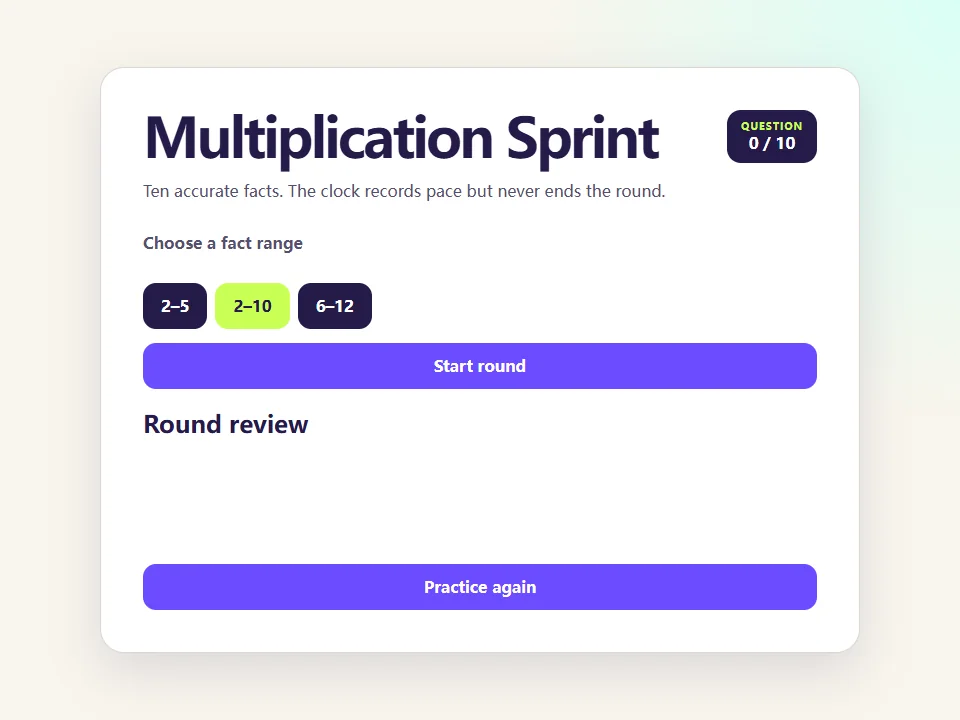
Multiplication Sprint is most useful when the selected fact range is narrow enough for a learner to notice patterns. In the current coolmath build, the player can choose 2–5, 2–10, or 6–12 before a round. That control matters more than the timer: it lets a Grade 3 or Grade 4 learner begin with familiar groups and lets an older learner isolate the facts that still cause hesitation.
Our direct test used correct answers, incorrect answers, skipped prompts, keyboard submission, and every available range on desktop and a 390-pixel touch viewport. The round-end review identifies missed facts. It does not diagnose why an answer was missed, so an adult or learner still needs to distinguish a calculation error from a typing slip.
Worked case: the 6 × 8 family
Suppose a learner answers 6 × 8 incorrectly twice. Repeating the full range immediately can hide that pattern among easier items. Pause and connect 6 × 8 to a known fact: five groups of eight are 40, so one more group makes 48. The related division statements, 48 ÷ 6 = 8 and 48 ÷ 8 = 6, make the fact a four-number relationship rather than an isolated string to memorize.
On the next round, ask the learner to say the strategy only when 6 × 8 or 8 × 6 appears. This keeps the game moving while making the troublesome fact visible. If the response becomes accurate but remains slow, that is progress; automatic recall can follow after the relationship is secure.
A five-day routine
Day one is a baseline round with no pressure to improve the score. Record no more than three missed or slow facts. On day two, model one relationship for each of those facts and play a single round. Day three uses the same range but asks for an estimate of which facts will feel easier. Day four mixes the range with a different representation, such as arrays drawn on paper. Day five repeats the baseline range and compares the error pattern, not merely the point total.
Keep each session to roughly five minutes of play plus a short review. Stop if speed pressure produces guessing, visible frustration, or repeated keying errors. A slower correct response with a stated strategy is more useful than a fast streak built from chance.
What the score can and cannot show
The score shows performance on the presented items under the current controls. It is not a grade-level assessment and does not prove durable recall. Item order, attention, device input, and familiarity with the interface all affect a short round.
Our editorial judgment is to use the game as a retrieval check after a learner has seen arrays, equal groups, or distributive strategies. It is a poor first introduction to multiplication because the compact prompt does not build those concepts by itself.
Questions families and teachers often ask
Should a learner repeat a perfect round? One confirmation round can show that the result was not a lucky sequence, but endless perfect rounds add little. Move to a wider fact range, ask for a related division fact, or stop. Should time be recorded? The game records elapsed time without ending the round. Use that number only to compare the same learner, range, device, and session conditions; never rank children from one short sample.
For US classrooms, fact-fluency expectations vary by curriculum and local pacing. The practical decision is whether recall frees attention for the current task. If a learner can reason accurately but needs a few extra seconds, preserve the strategy while building retrieval. If speed creates errors, narrow the range and remove public comparison.