
Scan before calculating
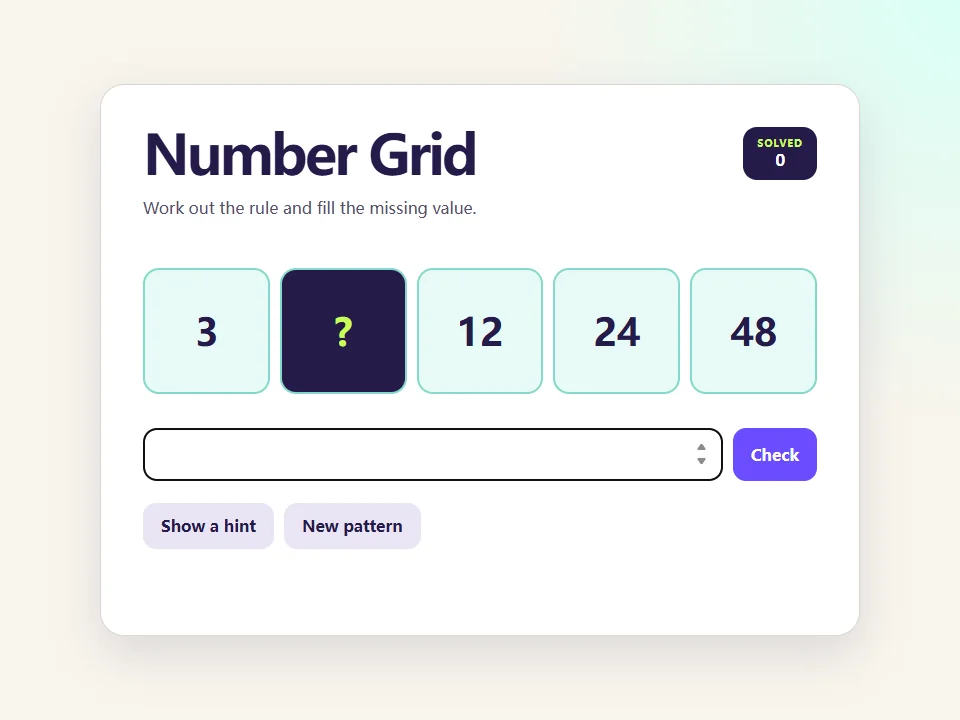
A grid makes several relationships visible at once. Begin by reading complete rows and columns rather than focusing on the blank. Look for a repeated step, a relationship between rows, or a common operation applied in the same direction. The strongest clue is usually the relationship that holds in more than one complete line.
Our current game uses reviewed boards with a known missing value and validates numeric input locally. We tested wrong answers, correct answers, blank submission, keyboard entry, and touch controls. The board confirms the intended rule but cannot rule out every imaginative pattern a reader could impose on a tiny set of numbers.
Worked case: confirm in two directions
Imagine rows 4, 7, 10 and 9, 12, 15, followed by 14, □, 20. Each row increases by three, suggesting 17. The columns also increase by five: 4, 9, 14; 7, 12, 17; and 10, 15, 20. Agreement in both directions makes 17 much stronger than a rule fitted only to the incomplete row.
If a proposed value works horizontally but breaks a simple vertical pattern, do not submit yet. State both checks. This two-direction habit is the grid equivalent of substituting an answer back into an equation.
When the first pattern fails
Write the differences between neighboring cells. If they are not constant, compare corresponding positions in adjacent rows. Then test multiplication, alternation, or a combination rule only when simpler relationships fail. Avoid switching rules midway merely to force a preferred answer.
A useful five-minute routine is: observe for 20 seconds, name one candidate rule, test it on every complete line, predict the blank, and explain one rejection. The rejection is valuable evidence because it shows the player is evaluating rules rather than decorating a guess.
Editorial judgment and limits
Short grids support pattern reasoning but do not prove that a mathematical sequence has one universally correct continuation. The game asks for the rule intended by the authored board. In open mathematics, another sufficiently complex rule can often fit the same finite values.
Use Number Grid when a learner can perform the underlying arithmetic and needs practice coordinating evidence. If basic addition or subtraction is consuming all attention, reduce the values or model the differences outside the game first.
Three failure cases worth discussing
The first failure is checking only the neighbors of the blank. A local relationship may fit those two cells while contradicting a complete row elsewhere. The second is switching operations whenever a value does not fit, producing a rule that describes positions after the fact but predicts nothing. The third is treating diagonal proximity as evidence when the authored structure uses rows and columns.
After an incorrect response, have the learner mark every transition explained by the proposed rule. A rule that covers two transitions and fails six should be rejected even if it looked promising near the blank. For US elementary classrooms, this evidence-marking routine supports mathematical-practice goals around noticing structure and justifying reasoning without claiming that the short puzzle is a formal assessment.
As a transfer activity, draw a new 3 × 3 grid with the same row and column changes, remove a different cell, and exchange it with a partner. Creating a valid board exposes whether the relationship was understood.
When creating a grid, calculate every cell before hiding one. A partner should be able to confirm the rule in at least two complete lines. If several simple rules produce different missing values, revise the board rather than insisting that intention alone makes one answer uniquely valid.