
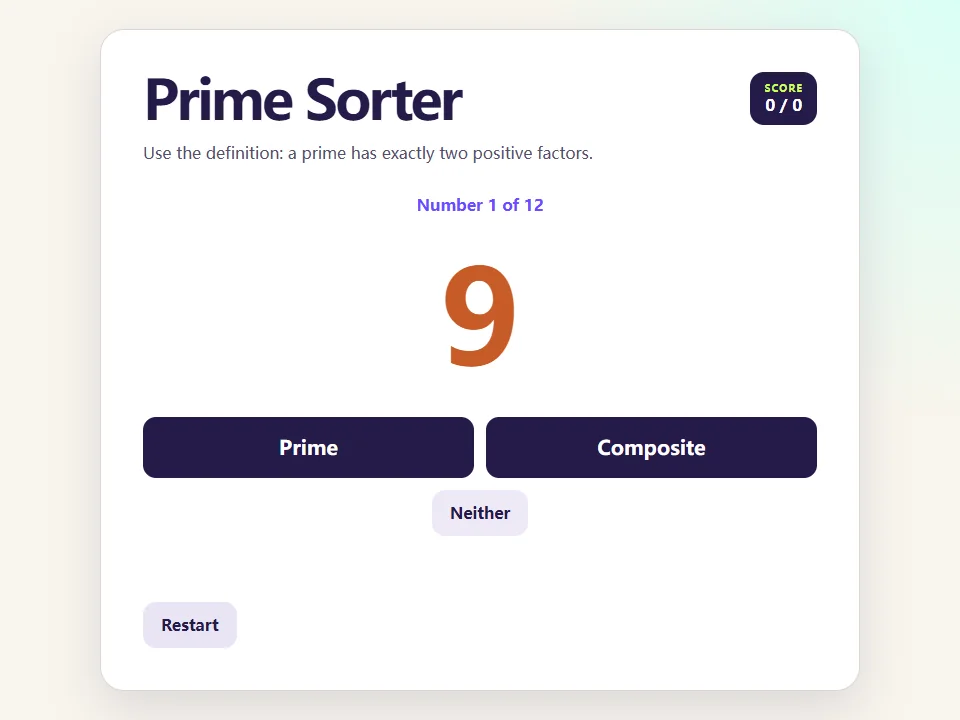
Prime means exactly two positive factors
A prime number has exactly two positive factors: 1 and itself. A composite number has an additional factor pair. The number 1 is neither prime nor composite. Prime Sorter computes the classification locally and, after a composite response, can display an actual factor pair rather than relying on a memorized label.
Our test covered small primes, squares, even composites, odd composites, and the boundary value 1. We compared the game result with divisor checks through the square root. The game is practice for classification; it is not a proof system for very large numbers.
Worked case: test 97 efficiently
The square root of 97 is a little under 10, so only prime divisors 2, 3, 5, and 7 need to be tested. The number is odd, its digit sum is 16, it does not end in 0 or 5, and 7 does not divide it evenly. No possible smaller factor remains, so 97 is prime.
Why can the search stop? If 97 had a factor larger than its square root, the paired factor would be smaller than the square root and would already have been found. Factor pairs prevent both factors from hiding above that boundary.
Worked case: do not trust appearance
The number 91 is odd and is not divisible by 3 or 5, but 7 × 13 = 91. Stopping after the easiest tests would misclassify it. By contrast, checking every number from 2 through 90 wastes effort. The square-root stopping rule gives a complete search with less work.
During a round, ask the player to name the first test used. For a composite classification, require one factor pair. For a prime classification, require the stopping boundary and the divisors checked.
Best use and limits
The game suits learners who understand factors and multiplication but need a systematic classification routine. It can also expose the misconception that all odd numbers are prime.
A correct button choice alone provides weak evidence. Our editorial recommendation is to use the feedback as the beginning of an explanation: composite answers need a factor witness, while prime answers need a complete bounded search.
A reusable decision routine
First handle boundary cases: 1 is neither prime nor composite, and 2 is the only even prime. Next reject even values greater than 2. Test divisibility by 3 using the digit sum, then 5 using the final digit. Continue with prime divisors no larger than the square root of the target. Stop immediately when a divisor is found; otherwise the completed bounded search supports a prime classification.
For 143, the square root is just under 12, so test 2, 3, 5, 7, and 11. The last test finds 11 × 13, proving that 143 is composite. For 149, the same list produces no divisor, supporting prime. Writing the tested divisors prevents skipped cases and makes the claim reviewable.
This routine is appropriate for the modest whole numbers in the game and typical US upper-elementary or middle-school factor work. It should not be presented as an efficient method for cryptographic-scale numbers, where specialized algorithms are required.
Perfect squares deserve extra attention because their final factor pair repeats one factor, such as 7 × 7 for 49. Count that as one pair, not two. The square-root boundary is included in the search, which is why checking 7 correctly classifies 49 as composite.
When feedback names a factor pair, multiply it aloud. That small verification prevents accepting a displayed label without connecting it to the definition of a composite number.