
The task is rule evaluation
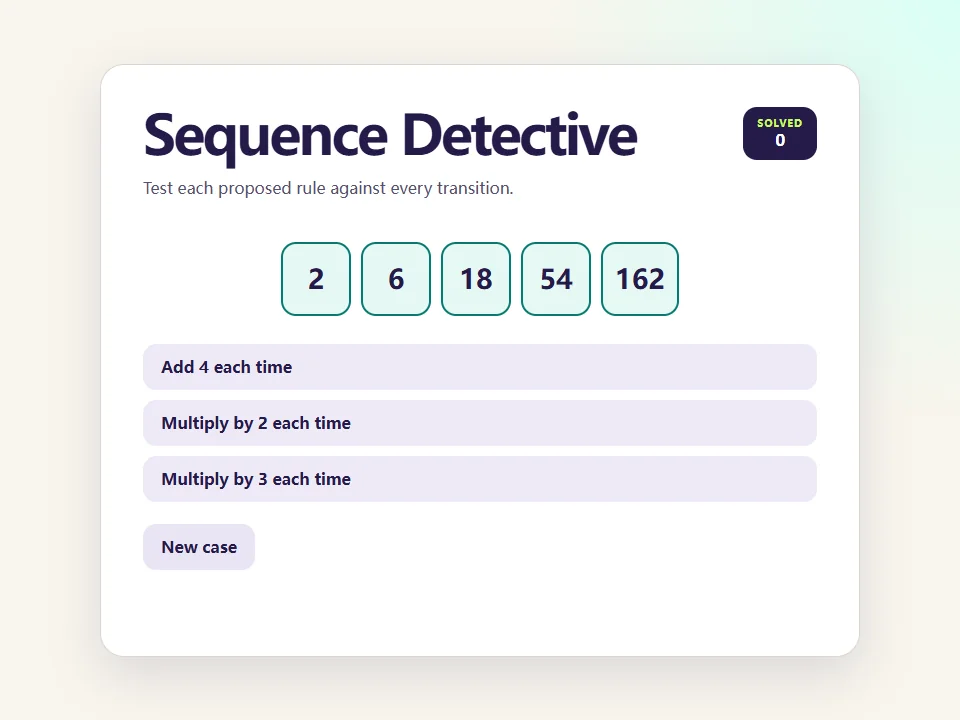
Sequence Detective shows a finite sequence and three explicit candidate rules. That design avoids claiming that a short list of numbers has only one imaginable continuation. The player’s job is narrower and more defensible: decide which offered rule generates every displayed transition.
We tested increasing, decreasing, alternating, and multiplicative items, including every candidate position and repeated rounds. The feedback validates the authored option. It does not establish that no other mathematical description could fit the same finite sequence.
Worked case: separate odd and even steps
For 3, 6, 5, 10, 9, 18, a single constant difference does not work. The transitions alternate: multiply by two, then subtract one. Check all five transitions before choosing that rule. Looking only at 3 to 6 and 5 to 10 might suggest doubling while ignoring the connecting steps.
Marking operation symbols between terms—×2, −1, ×2, −1, ×2—turns a visual hunch into a testable statement. If the final transition disagrees, the rule is not yet supported.
Reject distractors explicitly
When two options seem plausible, identify the first transition where each fails. “Add three” works for 3 to 6 but fails immediately for 6 to 5. “Double every term” also fails there. Explaining the earliest failure is faster and clearer than calculating many hypothetical future terms.
For a classroom pair activity, one learner defends a candidate and the other acts as a checker. They switch roles on the next round. This makes disagreement productive and reduces the tendency to select the first familiar phrase.
Best use and limitation
The game is a compact exercise in evidence checking, not a comprehensive lesson on functions or proof. It uses whole-number patterns and a fixed option set. A learner may succeed through elimination without being able to generate a rule independently.
Our judgment is to follow a round with one transfer prompt: create a new six-term sequence using the same rule. If the learner can generate and verify that example, the rule is more likely to be understood rather than merely recognized.
How to handle more than one plausible pattern
Finite sequences can support many formulas. In this game, fairness comes from comparing three stated candidates, not from declaring that the author discovered the only possible continuation. If a learner proposes another valid rule, test it across every displayed term and acknowledge it separately from the multiple-choice task.
For example, 1, 2, 4 can suggest doubling, but a polynomial or piecewise rule can also reproduce those three values and continue differently. Elementary and middle-school practice normally favors a simple, consistently repeated relationship because it is communicable and useful, not because alternative mathematics is impossible.
A classroom extension is to ask two groups to create different rules that share the first three terms, then reveal a fourth term that separates them. This demonstrates why additional evidence matters. It also turns a disagreement into model comparison rather than a contest over who guessed the teacher’s intention.
Vocabulary should remain precise: a term is one displayed value, a transition is the change between neighboring terms, and a rule must account for every transition in the presented list. Naming these parts helps a learner explain exactly where a rejected candidate fails.
Record the proposed rule in words and operation symbols. Two representations make ambiguous phrases such as “goes up” more exact and give another person enough information to reproduce the sequence.