
The fastest reliable approach
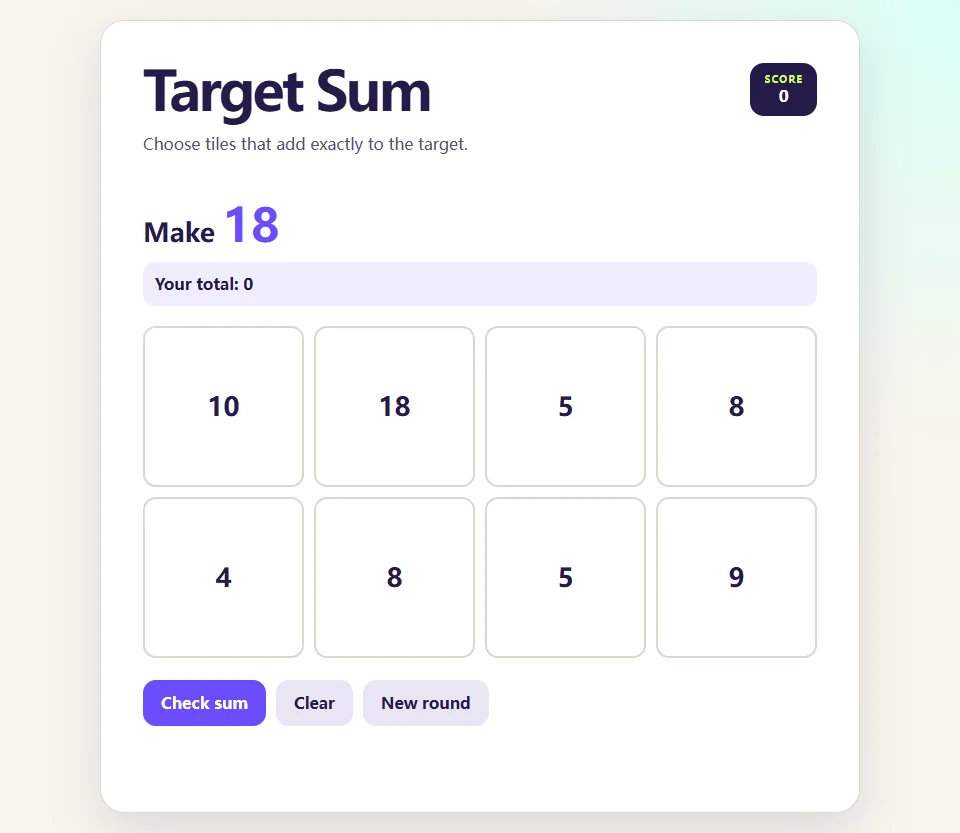
Target Sum asks you to select number tiles whose total equals the displayed target. The reliable approach is to start with a large useful tile, calculate the difference between that tile and the target, and then search for one or two tiles that make that difference. This turns a crowded board into a smaller missing-number problem.
The method comes from direct testing of the current coolmath version. The board displays eight whole-number tiles, keeps a visible running total, allows any selection to be cleared, and accepts more than one valid combination. Because the values change each round, remembering a previous answer is less useful than repeating a calculation strategy.
Worked case: make 31
Suppose the available tiles are 17, 14, 11, 9, 8, 6, 5, and 3, and the target is 31. Selecting 17 leaves a difference of 14. Because 14 is already present, 17 + 14 is a complete two-tile solution. Before submitting, read the running total rather than relying on memory.
There is also a three-tile solution: 17 + 9 + 5. After selecting 17, the remaining difference is 14; after adding 9, it is 5. Looking for the changing difference is more controlled than tapping several promising numbers and hoping the total lands correctly.
What to do when the total is too high
Going over the target is information. If the target is 31 and the chosen total is 36, the selection is 5 too large. First check whether one selected tile can be exchanged for another tile that is exactly 5 smaller. Replacing 14 with 9, for example, reduces the total by 5 without rebuilding everything.
When there is no clean exchange, remove the most recent tile and recalculate the difference. Clearing the whole board is appropriate when you can no longer explain how the total was formed, but it should not be the automatic response to every error.
Use pairs before long combinations
Two-tile solutions reduce working-memory demands. Scan the board by subtracting each large tile from the target. For a target of 28, a tile of 16 asks whether 12 is available; a tile of 19 asks whether 9 is available. Once likely pairs have been checked, move to three-tile combinations.
A useful three-tile method is to identify a familiar pair first. If 8 and 7 make 15 and the target is 24, the remaining tile must be 9. Grouping two values into a known subtotal keeps the reasoning visible and makes the final check easier.
A five-minute practice routine
Complete one round using any valid method. On the next round, say the remaining difference after every selection. For the third round, look for a second combination after finding the first instead of submitting immediately. Stop after about five minutes and describe which method reduced the most trial and error.
For a Grade 4 or Grade 5 learner in a US classroom or at home, the explanation matters more than a streak. Ask, “What number did you need after choosing 17?” rather than “Why were you slow?” The first question reveals decomposition strategy; the second mostly measures pressure.
Limits and editorial judgment
Target Sum is best for learners who can already add the displayed whole numbers and want practice composing a total in different ways. It is not an introduction to addition, because the game does not show counters, a number line, or place-value blocks. It also does not prove mastery from a high score.
Our judgment is to use the game as a short reasoning warm-up, then ask for one written equation that represents a successful selection. That small transfer from tiles to notation adds more instructional value than extending the same session until fatigue produces careless errors.