
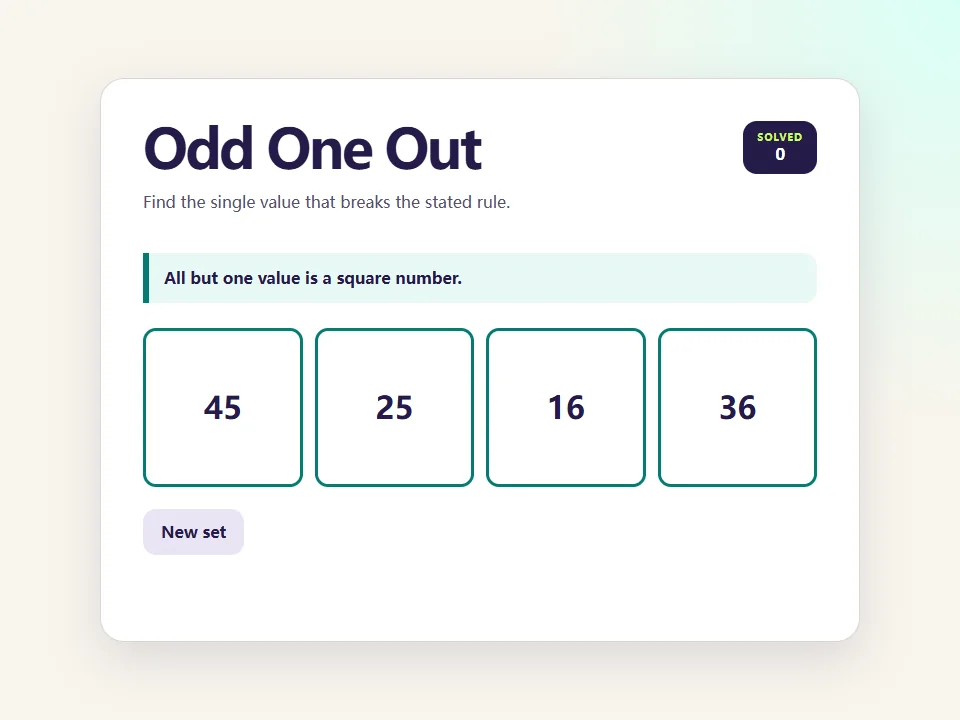
Start with the action, not the grade badge
Grade labels are a browsing shortcut, not a diagnosis. Students in the same class can differ in fluency, vocabulary, attention, and prior experience. Before choosing a game, identify the action you want repeated: recognizing a quantity, recalling a fact, comparing fractions, explaining a pattern, or planning several steps.
Then play one round yourself. If the mathematical decision is buried under fast movement or unfamiliar controls, the game may be testing reaction time more than the intended skill.
A worked example for Grades 4–5
Suppose a learner can add two-digit numbers on paper but hesitates when asked for different ways to make 30. Target Sum is a reasonable short practice because the player selects several values and sees a running total. Set a five-minute session and ask the learner to explain one successful combination afterward.
If the learner instead struggles to understand what addition represents, a visual number line or objects grouped into sets would be a better starting point. Selecting a harder game does not create a useful challenge when the representation itself is missing.
Use difficulty and time honestly
An easy label should describe the cognitive and control demands, not promise that every child will find the game easy. Short sessions work well for fluency and review. Longer puzzle sessions can support planning, but only when the player can pause, recover from a mistake, and understand the goal.
We favor a small set of well-matched games over a large playlist. Replaying a suitable game while discussing strategies usually provides more information than switching titles after every round.
What to observe after play
Ask what changed between attempts, which clue mattered, and how the learner checked the answer. A high score without an explanation may reflect guessing or quick controls. A lower score with a clear strategy can show more useful progress. Use the game as evidence for a conversation, not as a standalone grade.
A simple matching table for US classrooms
For Grades 3–4 arithmetic recall, choose a narrow multiplication range or a missing-value equation the learner can already model. For Grades 4–5 number sense, Target Sum, factor pairs, and decimal comparisons work when the learner can explain place value or decomposition. For Grades 5–6 fraction work, use equivalence matching or a number line only after equal partitions are understood. Logic games can suit several grades because reading load, planning depth, and control complexity matter as much as the numbers shown.
These ranges are editorial starting points based on the action in the current games, not claims that a title follows every state or district sequence. US standards and local curricula place topics differently, while UK, Canadian, and Australian terminology and year levels do not map one-to-one to US grades.
Run a three-question fit check
Before assigning a game, ask: Can the learner understand the goal without guessing at the interface? Does each turn repeat the intended mathematical decision? Does the feedback reveal enough to support a correction? If any answer is no, change the game, reduce the range, or teach the representation first.
After one round, ask the learner to solve a similar example away from the screen. A successful transfer is stronger evidence than a score increase. If performance collapses without the game layout, treat the session as interface practice rather than mastery of the underlying idea.