
Read decimals from left to right
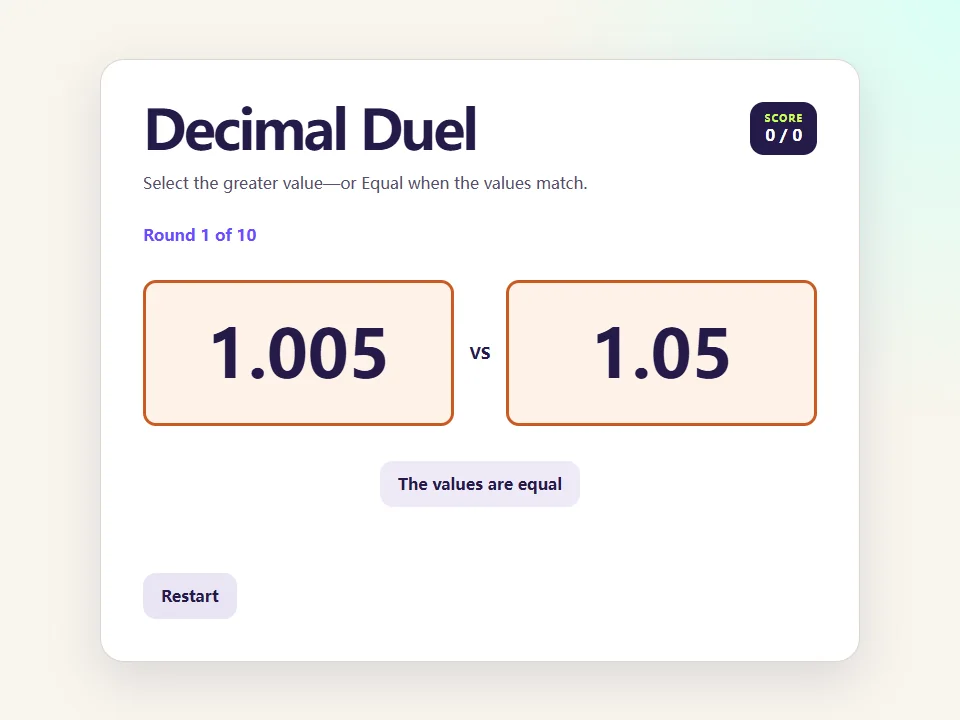
Decimal Duel shows two values and asks which is greater or whether they are equal. The dependable method is to compare whole-number parts first, then tenths, hundredths, and thousandths from left to right. Stop at the first place where the digits differ.
This guide is based on the reviewed item bank in the original coolmath game. The bank deliberately includes pairs with different text lengths, trailing zeros, and close values. Those cases expose whether a player is using place value or treating the digits after a decimal point like an unrelated whole number.
Worked case: 0.5 versus 0.45
A common wrong shortcut says that 45 is greater than 5, so 0.45 must be greater than 0.5. Instead, write an equivalent zero: 0.5 = 0.50. Both numbers have zero ones. In the tenths place, 0.50 has 5 tenths while 0.45 has 4 tenths, so 0.5 is greater.
The hundredths digit never reverses that result. Once 5 tenths is compared with 4 tenths, the decision is complete. This is why left-to-right comparison is more reliable than counting digits or reading the decimal part as a whole number.
Trailing zeros do not change the value
The pair 0.60 and 0.6 should be marked Equal. The extra zero represents zero additional hundredths. Likewise, 0.090 and 0.09 occupy the same point on a number line. Adding or removing trailing zeros after the final nonzero decimal digit does not change the amount.
This rule is different from adding a zero before an existing decimal digit. The values 0.6 and 0.06 are not equal: the 6 moves from the tenths place to the hundredths place. Use place names, not the visual length of the string, to explain the difference.
Close comparisons need aligned places
For 0.375 and 0.38, rewrite 0.38 as 0.380. The tenths digits are both 3. The hundredths digits are 7 and 8, so 0.380 is greater. There is no need to compare the thousandths digits after the first difference has been found.
For 1.09 and 1.1, align the values as 1.09 and 1.10. The whole-number parts are equal, but the tenths digits are 0 and 1. Therefore 1.1 is greater. Saying the place name aloud can prevent the familiar mistake of concluding that 09 is greater than 1.
A short error-checking routine
Before selecting an answer, ask three questions: Are the whole-number parts equal? What is the first decimal place that differs? Did I add equivalent trailing zeros only to align the places? This routine works for every pair in the current game.
After an incorrect answer, do not immediately memorize the correct side. Write the two values with the same number of decimal places and identify the first different digit. That reconstruction makes the feedback reusable on a new pair.
Who this game fits—and who needs another model
Decimal Duel fits learners who have already met tenths and hundredths and need focused comparison practice. It is especially useful when errors reveal whole-number thinking. A ten-round session creates enough examples to identify a pattern without requiring an account or saving a personal score.
A learner who cannot explain what one tenth represents should first use money, base-ten blocks, grids, or a number line. Our editorial judgment is that the game is a diagnostic practice tool, not a complete decimal lesson. Pair it with a representation when the same misconception appears twice.
Transfer the comparison away from the buttons
After a round, write one pair vertically with decimal points aligned and ask the learner to insert <, >, or =. Then place both values roughly on a number line from zero to one or between the surrounding whole numbers. Agreement between the place-value comparison and the estimated locations provides two forms of evidence.
US classrooms often connect decimals with money, but money stops naturally at hundredths. Use grids, metric measurement, or number lines when thousandths appear so the representation does not falsely imply that every decimal is a dollar amount.