
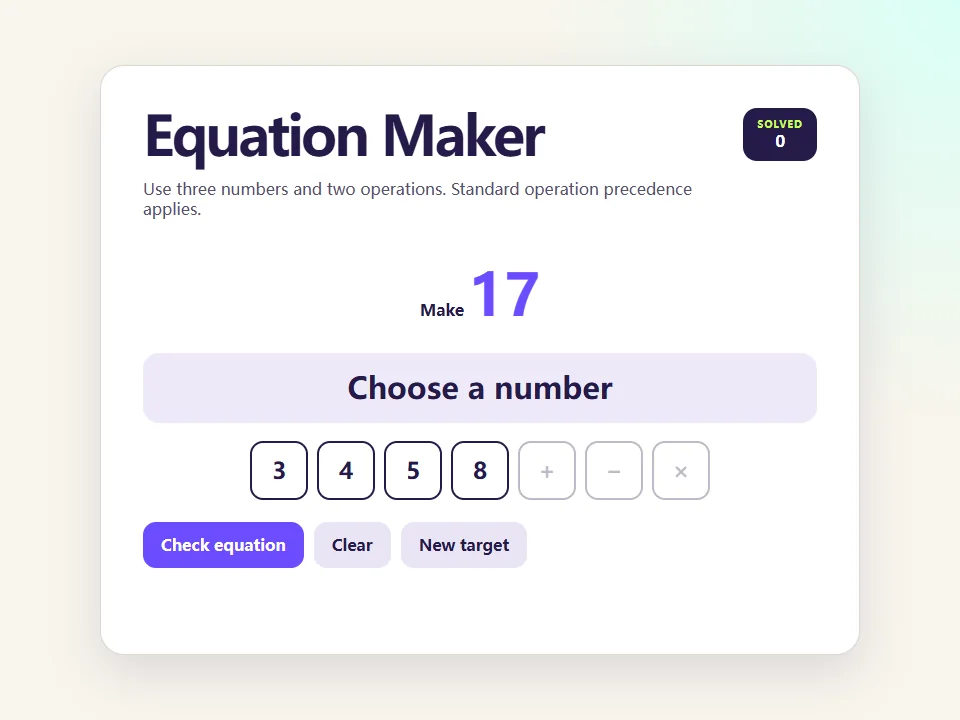
A playable game is only the starting point
A game can load correctly and still be a poor choice for a learner. Our review starts with the question the player is expected to solve, not with animation quality or a high score. We write down the mathematical action required in a successful turn, the knowledge a player must already have, and the feedback shown after a mistake.
For example, Target Sum requires a player to compose a total from several addends. That is different from memorizing a single addition fact. We therefore describe it as number-composition practice and do not claim that it teaches addition from the beginning.
The five-part test
First, we complete enough rounds to encounter the main rule, a mistake state, a restart, and a harder variation. Second, we repeat the game with every advertised input method. Third, we test a desktop viewport and a narrow touch viewport. Fourth, we inspect requests and storage so the privacy description matches actual behavior. Fifth, we record who benefits, who may struggle, and what instruction still needs to happen away from the game.
A game does not pass simply because it is fun. Instructions must be understandable, controls must be recoverable, and feedback must help a player distinguish a calculation error from an input error.
A concrete classroom check
Imagine a Grade 5 class with ten minutes left in a lesson. A teacher needs a game that opens without an account, works on a Chromebook, can be muted, and produces a meaningful stopping point. During our check we time the first successful round, note whether progress survives a refresh, and verify that the student can leave full screen without assistance. Those observations are more useful than a generic label such as educational.
Our recommendation is deliberately limited: use a game when its core action matches the day’s learning goal and when the teacher can explain what to notice. Do not use a score as proof that a student understands the concept.
Corrections and retesting
Browser behavior changes. We display a substantive update date and retest after a game release, a major browser change, or a credible reader report. Corrections that change compatibility, privacy, or the educational judgment are recorded rather than hidden behind a new date.
What we record in a test pass
A test record names the route, browser family, viewport, input method, observed learning action, error state, recovery control, network failures, console errors, and any horizontal overflow. For the current launch set, we run every game at 1280 × 800 and 390 × 844 pixels through the phpStudy NGINX environment. We also submit an answer or make a move, activate a reset or new-round control, and confirm that an interactive element can receive keyboard focus.
That checklist found a real integration defect: the first NGINX content-security policy blocked the inline game logic even though each URL returned HTTP 200. It also found a 60-pixel mobile overflow in Balance Builder. Both observations changed the build. This is why status-code checks alone are not enough evidence that a browser game works.
How readers should use our result
A passing test means the described version worked under the recorded conditions; it is not a promise about every browser, assistive technology, school filter, or future release. We separate direct observation from editorial judgment and name limitations on the game page. A teacher should still try the exact school device because managed Chromebooks, content filters, and extension policies can alter storage, full-screen behavior, or embedded frames.
If a reader reports a reproducible problem, the useful details are the page URL, browser and device, input method, expected action, observed result, and whether the failure persists after refresh. We use that evidence to reproduce and prioritize a correction.