Know exactly what one move changes
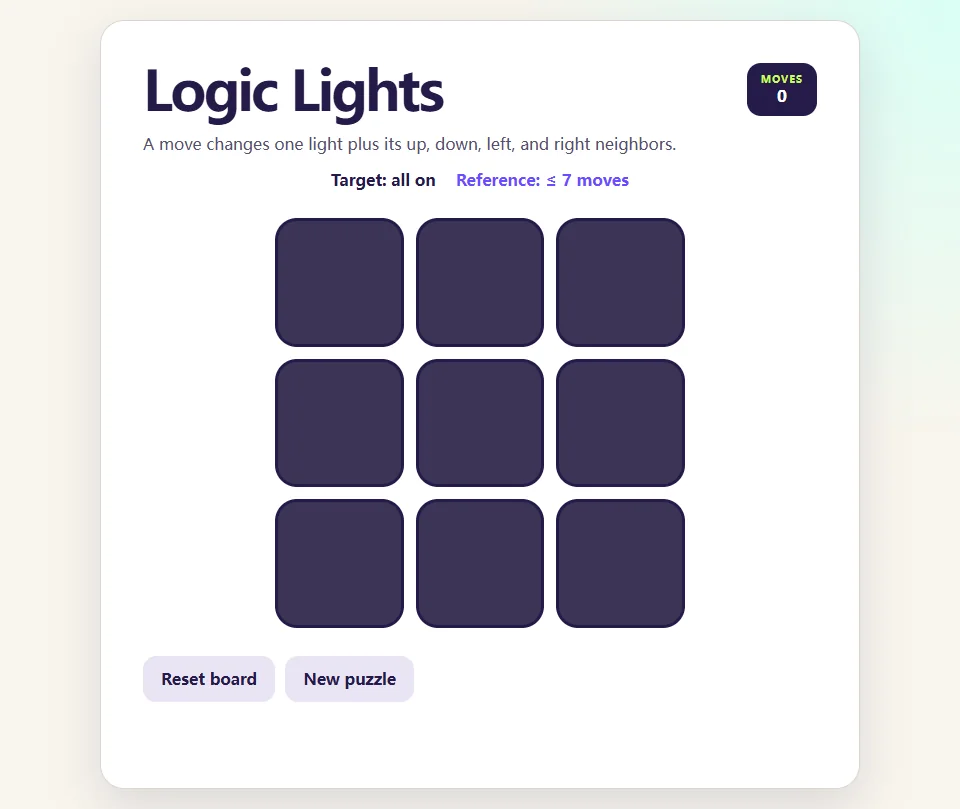
In Logic Lights, selecting a tile changes that light plus its horizontal and vertical neighbors. A corner affects three tiles, an edge-center affects four, and the center affects five. Diagonal tiles do not change. Every plan depends on keeping that neighborhood rule consistent.
The coolmath version creates each starting board by applying a small set of legal moves to an all-on board. That construction provides a known path back to the goal, although another solution may use a different order. The board is only 3 × 3 so a player can reason about the full state without scrolling or hidden information.
Why repeating a move never helps
A light has two states: on and off. Selecting the same tile twice changes the same group twice, returning every affected light to its previous state. Two identical moves cancel each other. Therefore a useful solution never needs the same tile more than once.
This observation reduces an endless-looking series of taps to nine yes-or-no decisions: use each position once or do not use it. Move order also does not change the final state because each affected light is toggled the same number of times. Order may help you track the board, but it does not create a different mathematical outcome.
Worked observation: start with corners
Suppose the top-left corner is off while its two adjacent edge tiles are also off. Selecting that corner changes exactly those three visible positions, so it is an efficient candidate. If the center is off but several surrounding positions are already correct, selecting the center may disturb five cells and should be evaluated more carefully.
This is not a universal rule that corners must be played first. It is a way to compare the cost of a move with the cells that need changing. Count how many affected cells are currently wrong and how many are currently right before choosing.
Use reset as part of reasoning
The Reset Board control restores the same puzzle and sets the move count to zero. Use it when you have stopped tracking which positions were selected. A reset is not failure; it preserves the evidence from the first attempt while removing accidental repeated moves.
Before resetting, name one discovery: perhaps the center move changed too many already-correct cells, or two corner moves fixed the top row. On the next attempt, preserve that useful choice and change one later decision. This is controlled variation rather than starting randomly again.
A seven-move planning challenge
The interface shows a reference goal of seven moves or fewer. Reachability matters first. Once the board is all on, reset the same puzzle and look for canceled or unnecessary choices. Because repeating a position cancels, a recorded sequence with duplicate positions can be shortened immediately.
For a classroom pair, one student can select moves while the other records tile positions as corner, edge, or center. Switch roles after a reset. Requiring a prediction before each click turns the puzzle into a conversation about cause and effect instead of a race.
Limits and recommended use
Logic Lights practices planning, reversible operations, and spatial cause-and-effect. It does not directly teach a grade-level arithmetic standard, and solving one board is not evidence of general logical ability. Larger versions also require strategies beyond what a 3 × 3 board reveals.
Our judgment is to use it as a short logic break or an introduction to state-changing systems. Ask the player to explain why duplicate moves cancel. That explanation demonstrates more transferable reasoning than the final move count alone.